Free Ebook Inside the Atheist Mind: Unmasking the Religion of Those Who Say There Is No God, by Anthony DeStefano
When other peoples are still waiting on guide available in the book shop, you have actually done the excellent way. By visiting this website, you have been 2 progressions. Yeah, in this site, the soft file of the Inside The Atheist Mind: Unmasking The Religion Of Those Who Say There Is No God, By Anthony DeStefano is provided. So, you will not run out to have it as your own. In this website, you will certainly discover the web link and the link will certainly assist you to obtain guide file directly.
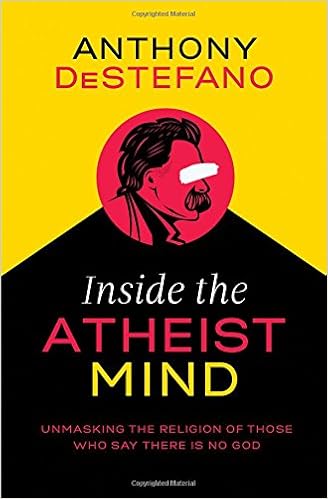
Inside the Atheist Mind: Unmasking the Religion of Those Who Say There Is No God, by Anthony DeStefano

Free Ebook Inside the Atheist Mind: Unmasking the Religion of Those Who Say There Is No God, by Anthony DeStefano
Following the great practice will reveal the great behavior, also. When having a great friend that has reading behavior, it is needed for you to have that such practice. Well, even checking out is actually not your design, why don't you try it as soon as? To attract you to love reading, we will certainly present Inside The Atheist Mind: Unmasking The Religion Of Those Who Say There Is No God, By Anthony DeStefano currently. Here this book has the tendency to be one of the most referred book that lots of people read it.
This is the book that will certainly urge you to invest more times in order making much better idea of info and understanding to attach to all people worldwide. One of guides that current has been released is Inside The Atheist Mind: Unmasking The Religion Of Those Who Say There Is No God, By Anthony DeStefano This s the kind of publication that will certainly end up being a brand-new way to the people is drawn in to review a publication. This publication has the tendency to be the fashion for you to link one individuals to others that have very same leisure activity, reading this book.
Whether people have reading practice allots to boost the level of the life quality, why don't you? You can additionally take some means as what they additionally do. Reading Inside The Atheist Mind: Unmasking The Religion Of Those Who Say There Is No God, By Anthony DeStefano will offer its benefits for all individuals. Certainly, those are the people who truly reviewed guide and comprehend it well regarding just what the book really means.
After getting the web link, it will additionally make you feel so simple. This is not your time to be perplexed. When the book is collected in this site, it can be got quickly. You can likewise save it in various devices to ensure that you can take it as reading products wherever you are. So now, allow's seek for the inspiring resources that are very easy to acquire. Get the different ways from other to relieve you really feel so very easy in obtaining the resources.
About the Author
Anthony DeStefano is the best-selling author of A Travel Guide to Heaven, Ten Prayers God Always Says Yes To, and A Travel Guide to Life, as well as many children’s books. He has appeared on many national television and radio programs, including Fox’s America’s Newsroom, Fox and Friends, CNN, 700 Club, Focus on the Family Radio, and Janet Parshall’s In the Market. He lives in New York City.
Read more
Product details
Hardcover: 256 pages
Publisher: Thomas Nelson (March 20, 2018)
Language: English
ISBN-10: 0718080564
ISBN-13: 978-0718080563
Product Dimensions:
5.8 x 0.9 x 8.7 inches
Shipping Weight: 11.7 ounces (View shipping rates and policies)
Average Customer Review:
3.6 out of 5 stars
112 customer reviews
Amazon Best Sellers Rank:
#63,099 in Books (See Top 100 in Books)
This is a critical review and I state that just as a distinction from a "negative" review because I know it is all too easy and common for believers to assume criticism on such issues as invalid coming from anyone outside (or even inside) the Christian community. I was part of the Christian community for decades, I prayed the prayer, I walked the aisle, I know what the Church looks like within and without. I AM someone who appreciates a lively debate on an issue, intellectual honesty, in-depth analysis and learning from those with a different take on an issue.The first and foremost important criticism of this book is that the title is misleading. The more accurate title of this book would be: "Inside the Christian Mind: Unmasking The Evangelical Fear Of Atheists". When the author attempts to get inside the mind of atheists, he only does so from his own perspective. If one truly wanted to write about the subject of the title instead of writing from a blatantly Christian perspective the author might have been able to find the humanity of the subject and provide some insight. As it reads, it is clear that the author is dismissive, even disdainful of atheism intellectually, emotionally, and morally. My questions to the author would include: how many atheists did you interview for this book? Did you really take the time to get to know any atheists as real people or learn about their thoughts on these topics?Based on the Author's book it seems Christians have a lot to be proud of, given that they alone seem to be the source of nearly all the goodness and progress in human history. To be certain, Christian organizations deserve much credit for hospitals, universities and charities of many kinds. Christian contributions to medicine, science, music, the arts and all kinds of benevolence are each an indelible part of Western civilization and world history. The influence and benefits of Christian virtues and goodness are incalculable, but that is not the whole story. Just as much as the positives must be accounted for, the negatives must also be included in an honest assessment of history.In the book's praise of Christianity's seeming monopoly on science, medicine and culture it widely ignores the influence and contributions of the other cultures. For centuries Muslim and Asian cultures were far more advanced than the West in science, mathematics, astronomy etc. For example, the number system we use (1,2,3 etc.) to this day in the West are called Arabic numerals, several cultures outside Europe independently invented the concept of the number zero, gunpowder was invented in China, etc. As with so many issues, we cannot ignore the contributions of others just to serve a convenient narrative (in this case: Christian superiority in the realm of science).The book also takes credit for much of the progress made over the past few centuries: ‘the ancient world was built on the backs of slaves but Christianity values human equality and dignity!’ According to the author the concepts of private property, workers’ rights and unionization have Christianity to thank for their very existence. And while many of those ideas have roots in Christian texts (both the Bible and other Christian-influenced philosophers), how many slave owners used those very scriptures to justify the owning of other human beings? How many centuries did kidnapping, rape, torture and murder of slaves continue while the rich and powerful men in Europe and the Americas turned a blind eye to the atrocities? Not to discount those who opposed slavery, but such a system could only continue to operate with the tacit consent of countless officials of whom the VAST majority were white male Christians. This is another example of the false premise that somehow Christians have a greater compassion and moral compass than other ‘non-believers’.The author takes every possible opportunity to remind the reader of all the atrocities that have occurred under non-religious governments: Hitler’s Third Reich; Stalin’s Russia, and Mao’s China killed tens of millions in the 20th century. Terrible acts and a tragic loss of life without question, yet none of those millions were slaughtered for the purpose of atheistic aims. Each of those savage governments essentially substituted the State itself as the state sanctioned religion rather than to allow religious freedom, that is not atheistic government but a cult of worship under fear of punishment.While repeatedly attempting to link atheism to murderous regimes, the author also gives a pass to religious involvement in the Middle Age involvement in the Crusades and Spanish Inquisition. The author states that there is no way to have accurate numbers on how many people were put to death during the Spanish Inquisition and the likely number is “only about 3,000â€. Well, I’m sure those 3,000 murdered people feel so much better that it was really no big deal. The Crusades also had an estimated 1,000,000 people who died in those wars, but they were spread out over nearly 200 years so it must be not as terrible, right? After all, if it happened a long time ago and the records aren’t very precise then the Church gets a free pass apparently. The irony of the Church attempting to convert others to their beliefs, or punish them for failing to hold their beliefs, is that in Ancient Rome there were examples of Christians being punished for their beliefs; in fact, their new religious sect was considered atheism at one time!In nearly every chapter of his book, the Author states that atheists love using “Straw-man argumentsâ€, yet in each and every chapter the author sets up his own straw-men only to knock them down with ease. For example, on page 78 he explains what easy opponents straw-men are and in the same paragraph calls atheists ‘nothing but dim-witted bullies…cowards…’. I suppose because he likes a side of ad-hominem with his straw-man. There are too many straw-men to even list, but most of them are based on little more than a quote from a blog or an atheist celebrity who says something that is disagreed with, repeatedly showing contempt for not just atheistic ideas but the people who hold them.Another issue with this book is that in its zeal to ‘disprove’ the atheist position it spouts the same tired clichés. ‘Atheism is a religion!’ Nope. ‘Atheists hate God!’ Funny! ‘Hordes of atheists are out to get you and your children!’ Certain American denominations have been preaching that directly and indirectly for decades, and it is a useful boogieman to keep the flock in line but it is little more than an anecdote. How many Christians who honestly are worried about the influence of atheists on them or their children have sat down and shared a meal with an atheist? To speak with someone who has different beliefs about such important issues is always enlightening, and opening up a dialog in an honest and vulnerable way helps us connect with another on a very human level instead of just spouting talking points at each other.An oft-repeated idea that many a Christian used is “If I was an atheist I could do anything I wanted!†Essentially, ‘I could steal, rape, kill or anything I wanted. And why not? It’s not like a god will punish me for it!’ But if atheists are such awful people, one must ask, are the prisons then brimful of atheists? Looking at statistics from the Federal Bureau of Prisons shows that about 0.10% of the prison population are atheists, while over 50% of prisoners are Catholic or Protestant. Did someone forget to tell the thousands of Christians who are convicted of crimes each year that only atheists are supposed to do that?Perfectly illustrating the mischaracterized idea that so many Christians seem to have about atheists is a line from page 89 in which the author states, “The bottom line is that an atheist may act in a virtuous manner—but not because he must. Without God, moral precepts are simply personal codes of conduct.†YES. It is ALWAYS a choice, for atheists, for Christians, for everyone. What kind of argument is it that a virtuous atheist is somehow lesser than virtuous theist? Is a virtuous atheist better than an unvirtuous believer? Is an atheist child molester worse than a Christian child molester? If the only thing that keeps a religious person from being a murderer, a thief or a rapist is the threat of divine punishment or the hope of a heavenly reward then that person is NOT a good person.It seems to me that this book is another product of the religious right having lost their way. Christian thinkers and activists such as Bonhoeffer, Kierkegaard, Martin Luther King Jr. (among others) were each men of conviction who contributed ideas or actions to a cause bigger than themselves. The American religious right however, appears to have sold their soul decades ago when any shred of focus on virtue and spiritual growth was exchanged for short-term political power and greed. They sold out and they were bought up cheap.Finally, perhaps at some point Christians in America will have had enough of an “Us versus Them†mentality and will change their attitudes regarding those who believe differently, that day will be a welcome relief for all sides. For too long the religious right have claimed to be concerned with the moral decay in America, yet have thrown their lot in with political Pharisees again and again. Their politicians have become more and more likely to embody everything they claim to oppose: lying, cheating, bigotry, racism, inequality and narcissism. Just looking at the characteristics the author attempts to apply to atheists, one can clearly see the current red-hatted savior within: arrogant, ignorant, ruthless, intolerant, shallow, cowardly, death-centered, malevolent. The Christianity I grew up knowing used to take things like charity, humility and kindness seriously but it seems that the Good News has been replaced by “Fake News!!!â€
I would have considered this book to be clever had it been written tongue in cheek. However, it was not.Anthony DeStefano reminds me of tge worst kind of preacher. The kind who decides that he knows the truth and reads his dogma into the Bible instead of legitimately seeking truth.In short, this book is not only very poorly researched, but Destano's arguments tend to teater on being hilariously ironic as he is often guilty of committing the same fallacies that he accuses atheists of as he presents his long winded, arrogant, and ignorant perception of how atheists are guilty of said fallacies.For this reason... I'll be honest, this was a pretty fun book to read. It reminds me very much of when I was trying to share the gospel with a homeless gentleman who was as opinionated and arrogant as he was ignorant.As such, even though this book deserves negative stars for how bad it is, I decided to still give it a star.
Bertrand Russell, perhaps an “old atheist,†wrote many decades that “the good life is one inspired by love and guided by knowledge.†Anthony deStefano makes a compelling case of just how far the most prominent “new atheists†of our day fall woefully short of the mark in both knowledge and love. Those who see these writers as paragons of intelligence, compassion, and moral enlightenment would do well to read these pages (especially before posting a review) to see the new atheists' malevolence, ignorance, ruthlessness, intolerance, and more exposed, not merely through the kinds of bombastic ad hominen and straw man arguments they so often employ, but through their own words, factual data, and well-articulated logical arguments.
1. As I look down over the other reviews, I noticed that only 3 people in the 1 star category were verified purchases and only 1 in the 3 star was a verified purchaser.2. Of course atheists are going to give it a bad review. We watched Mr DeStefano on EWTN and he even said that most of the reviews came out before the book was even released.3. I believe in the Holy Trinity and I pray for those who do not. May God have mercy on your souls.
Quite the rant! I thought it was an amusing read, but honestly, if your faith is strong, you won't need this book. What others think will not matter to you. If it does, you need to reevaluate yourself, and your faith.
The book attacks atheists as many people attack theists, such as Richard Dawkins. The author presents good evidence in his arguments, as he snaps back at common atheist beliefs. His position isn't one directly towards christianity, although it is close. His argument in this book is directly towards proving athiesm is unproductive. I have yet to read a book with such a position, so I am happy to have it in my collection
A bit repetitive but very convincing. Well documented.
Inside the Atheist Mind: Unmasking the Religion of Those Who Say There Is No God, by Anthony DeStefano PDF
Inside the Atheist Mind: Unmasking the Religion of Those Who Say There Is No God, by Anthony DeStefano EPub
Inside the Atheist Mind: Unmasking the Religion of Those Who Say There Is No God, by Anthony DeStefano Doc
Inside the Atheist Mind: Unmasking the Religion of Those Who Say There Is No God, by Anthony DeStefano iBooks
Inside the Atheist Mind: Unmasking the Religion of Those Who Say There Is No God, by Anthony DeStefano rtf
Inside the Atheist Mind: Unmasking the Religion of Those Who Say There Is No God, by Anthony DeStefano Mobipocket
Inside the Atheist Mind: Unmasking the Religion of Those Who Say There Is No God, by Anthony DeStefano Kindle

0 komentar: