Download PDF Macroeconomics and New Macroeconomics
If Macroeconomics And New Macroeconomics is one of the alternatives to check out the book, you could follow what we will tell you currently. Finding guide may need even more times when you are browsing from store to store. We have brand-new means to lead you get this publication swiftly. By visiting this web page, it becomes the primary steps to obtain the book carefully. This page is kind of online collection that serves so many book collections.
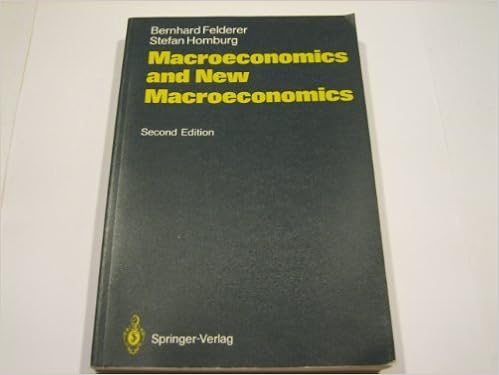
Macroeconomics and New Macroeconomics

Download PDF Macroeconomics and New Macroeconomics
Story of the hobby and life of everyone will certainly be distinctive. The experience, journey, knowledge, as well as life has be done become the variables of the problem. However, age doesn't become the factor of just how an individual ends up being smarter. To be a clever individual, several methods can be done. Knowing faithfully, finding out by doing and also practising, obtaining experience as well as understanding from other people, and getting sources from guide become the methods of being smarter.
Any kind of books that you check out, regardless of just how you obtained the sentences that have actually been read from the books, undoubtedly they will offer you goodness. But, we will certainly reveal you among suggestion of guide that you need to read. This Macroeconomics And New Macroeconomics is what we certainly suggest. We will certainly reveal you the sensible reasons you have to read this book. This publication is a type of priceless book created by an experienced writer.
The factors that make you have to read it is the associated subject to the condition that you really want right now. When it's mosting likely to make better opportunity of reading materials, it can be the way you need to absorb similarly. Yeah, the ways that you can take pleasure in the moment by checking out Macroeconomics And New Macroeconomics, the moment that you could make use of to do great activity, and the moment for you to get exactly what this publication offers to you.
To get this book, it will certainly be so basic. This time, you have actually been in the ideal web site. We are the online book library that gathers many book collections from numerous catalogues and also nations. So below, you will not just find this Macroeconomics And New Macroeconomics, you could likewise discover the other excellent motivating books from several sources. It is so simple when you discover guide by looking the title that you require. Numerous collections are preferred. So, simply be right here at the time when you wish to browse guide.
Product details
Paperback: 329 pages
Publisher: Springer Verlag; Subsequent edition (December 1, 1992)
Language: English
ISBN-10: 0387553185
ISBN-13: 978-0387553184
Product Dimensions:
6.8 x 0.8 x 9.8 inches
Shipping Weight: 1.3 pounds (View shipping rates and policies)
Average Customer Review:
2.0 out of 5 stars
1 customer review
Amazon Best Sellers Rank:
#965,955 in Books (See Top 100 in Books)
The authors' of this book seek to evaluate " What did Keynes mean " in terms of " modern " day macroeconomic theory,which is built on the assumption that the normal distribution (log normal)is an accurate approximation and description of the role of expectations as it applies to markets. All New Classical,rational expectations,real busines cycle ,and New Keynesian economics is built on the normal distribution.The other side of the coin is that the microeconomic foundations of macroeconomic behavior are assumed to be specified by SEU (Subjective Expected Utility)theory,which is just a more mathematically advanced version of Jeremy Bentham's original Benthamite Utilitarianism of 1787.In other words,modern macroeconomics,without any empirical or experimental support from goodness of fit tests or exploratory data analysis,simply " assumes a can opener",i.e.,that all comsumers and producers who are rational are able to calculate the odds of all outcomes,specify all the possible outcomes ,and then calculate and act upon their expected values or expected utilities.Keynes correctly identified this approach as a very special one with practically no theoretical relevance in the real world .The best way to understand what Keynes did in the General Theory is to compare his general theory of decision making ,as illustrated by the c coefficient model Keynes presented in chapter 26 of the A Treatise on Probability (1921) ,with SEU.One can then effortlessly conclude that " Modern " macroeconomcs is just a very special case of Keynes's general theory whcih assumes linearity and additivity so that one can assume a normal distribution. Keynes presented a clearcut mathematical,technical analysis of ambiguity aversion using his conventional coefficient of risk and weight( uncertainty),c,in chapter 26 of the TP. A very specific example of Keynes's nomlinear and non additive approach to probability in chapters 15,17,20,and 22 of the TP was worked out in great detail by Keynes in chapter 26 using his conventional coefficient of risk and weight ,c, on p.314 and in Footnote 2 on p.314.Edgeworth, in his 1922 article on " The Philosophy of Chance " in Mind ,was certainly correct in asking for the help of the readers of that philosophy journal in order to figure out the what and the why's involved in the application of Keynes's c coefficient.This will be provided for the reader below since it was never done in Mind or anywhere else with the exception of Brady's work.The foundation of Neoclassical economics is merely the mathematical development of a theoretical approach first proposed by Jeremy Bentham in 1787.Bentham claimed that all individuals have the capability to calculate the odds and outcomes and act on the expected value (the probability times the outcome) in a rational way.This can be expressed by the following ,where p is the probability of success and A is the outcome:Maximize pA.The modern version of this is to Maximize pU(A),where p is a subjective probability that is additive,linear,precise,and exact.U(A) is a Von Neumann-Morgenstern Utility function.The goal is toMaximize pU(A).The modern name for Benthamite Utilitarianism in neoclassical economics is SEU theory(Subjective Expected Utility).Therefore,a microeconomic foundation based on Utility Maximization is just Benthamite Utilitarianism updated with modern mathematical techniques.Modern macro is all SEU theory.Keynes rejected Benthamite Utilitarianism as a very special case that would only hold under the special assumptions of the subjectivist,Bayesian model-that all probabilities were additive,linear,precise,single number answers that obeyed the mathematical laws of the probabiity calculus.Keynes specifies his conventional coefficient of risk and weight,c, model in chapter 26 of the TP on p.314 and footnote 2 on p.314,as a counter weight to the Benthamite Utilitarian approach.Essentially, Keynes's generalized model is given byc=2pw/(1+q)(1+w),where w is Keynes's weight of the evidence variable that measures the completeness of the relevant, available evidence upon which the probabilities p and q are calculated.(Benthamite Utilitarians assume that the value of w is always equal to 1.)w is an index defined on the unit interval between 0 and 1,p is the probability of success,and q is the probability of failure.p+q sum to 1 if they are additive.This requires that w=1.Keynes's c coefficient can be rewritten asc=p [1/(1+q)][2w/(1+w)].Now multiply by A or U(A).One obtainscA= p[1/(1+q)][2w/(1+w)]A.The goal is to maximuze cA or cU(A).The weight 1/(1+q) deals with non linearity.The weight 2w/(1+w) deals with non additivity.Modern Macroeconomics amounts to nothing more than the claim that c=p or cA (cU(A)= pA (pU(A)) .It is now straightforward to see that the neoclassical microfoundations of macroeconomics assumes that all probabilities are additive and linear.This is nothing but a special case of Keynes's generalized decision rule to maximize cA,or cU(A),as opposed to the Benthamite Utilitarian pA or neoclassical pU(A).It is now clear that Keynes had created general theories of macroeconomics,probability,and decision making between 1921 and 1936.Keynes's accomplishments,once understood,make him the only rival to Einstein for the title of the greatest scientist of the 20th century. Economists have only a very vague,hazy,cloudy understanding of Keynes 's distinction between risk and uncertainty . It is this distinction that has to be grasped first before any economist can have any hope of understanding what Keynes means in the GT.The conclusion is very straightforward. New Classical,New Keynesian,rational expectationist,and real business cycle theorists use the rule to Maximize pU(A).Keynes used the rule to maximize cU(A).This is the same type of rule used by the overwhelmingly ambiguity averse decision makers that populate the real world. All versions of neoclassical economics are logically consistent ,special case of Keynes's general theory.Keynes did for economics what Einstein did for physics.The difference is that economists rebeled against Keynes,choosing to maintain the fiction that the normal probability distribution was applicable in macroeconomic theory.
Macroeconomics and New Macroeconomics PDF
Macroeconomics and New Macroeconomics EPub
Macroeconomics and New Macroeconomics Doc
Macroeconomics and New Macroeconomics iBooks
Macroeconomics and New Macroeconomics rtf
Macroeconomics and New Macroeconomics Mobipocket
Macroeconomics and New Macroeconomics Kindle

0 komentar: