Free Ebook The Perfectionists: How Precision Engineers Created the Modern World, by Simon Winchester
If The Perfectionists: How Precision Engineers Created The Modern World, By Simon Winchester is among the alternatives to check out the book, you can follow exactly what we will tell you now. Discovering guide could require more times when you are looking from shop to shop. We have new way to lead you get this book rapidly. By seeing this page, it becomes the primary steps to get the book finely. This page is type of on-line collection that serves so countless book collections.
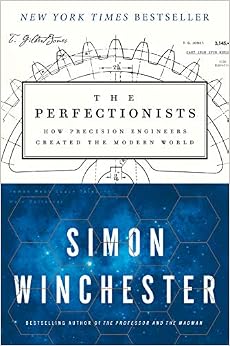
The Perfectionists: How Precision Engineers Created the Modern World, by Simon Winchester

Free Ebook The Perfectionists: How Precision Engineers Created the Modern World, by Simon Winchester
The Perfectionists: How Precision Engineers Created The Modern World, By Simon Winchester. In what case do you like checking out so much? Just what about the sort of the book The Perfectionists: How Precision Engineers Created The Modern World, By Simon Winchester The requirements to read? Well, everybody has their own factor why needs to read some e-books The Perfectionists: How Precision Engineers Created The Modern World, By Simon Winchester Primarily, it will connect to their requirement to get understanding from guide The Perfectionists: How Precision Engineers Created The Modern World, By Simon Winchester and intend to read just to obtain enjoyment. Novels, tale book, and various other amusing publications become so preferred this day. Besides, the clinical books will additionally be the very best reason to choose, especially for the students, instructors, medical professionals, business person, and also various other professions which enjoy reading.
Besides, the book is recommended due to the fact that it offers you not only enjoyment. You can change the fun things to be great lesson. Yeah, the author is actually clever to share the lessons and also material of The Perfectionists: How Precision Engineers Created The Modern World, By Simon Winchester that could attract all readers to admire of that publication. The writer additionally provides the easy way for you to obtain the enjoyable enjoyment. Read every word that is used by the writer, they are actually fascinating as well as straightforward to be constantly comprehended.
It won't take more time to download this The Perfectionists: How Precision Engineers Created The Modern World, By Simon Winchester It won't take even more money to print this e-book The Perfectionists: How Precision Engineers Created The Modern World, By Simon Winchester Nowadays, people have actually been so smart to use the modern technology. Why don't you use your gizmo or other gadget to conserve this downloaded soft data e-book The Perfectionists: How Precision Engineers Created The Modern World, By Simon Winchester This way will certainly let you to consistently be accompanied by this publication The Perfectionists: How Precision Engineers Created The Modern World, By Simon Winchester Naturally, it will certainly be the finest buddy if you read this e-book The Perfectionists: How Precision Engineers Created The Modern World, By Simon Winchester till completed.
But, the existence of this publication has the way exactly how you really require the far better option of the brand-new updates. This is what to recommend for you in order to obtain the opportunities of making or developing new book. When The Perfectionists: How Precision Engineers Created The Modern World, By Simon Winchester becomes one that is popular today, you have to be one part of such many people who always read this publication and also get this as their friend.
Review
“Winchester is a longtime journalist turned author, a meticulous researcher and catholic thinker.” (--James Gleick, The New York Review of Books)“Another gem from one of the world’s justly celebrated historians specializing in unusual and always fascinating subjects and people.” (Booklist (starred review))“Winchester’s latest is a rollicking work of pop science that entertains and informs.” (Publishers Weekly (starred review))Praise for The Men Who United the States: “Entertaining. . . . A pleasure.” (New York Times Book Review)“Simon Winchester never disappoints, and The Men Who United the States is a lively and surprising account of how this sprawling piece of geography became a nation. This is America from the ground up. Inspiring and engaging.” (Tom Brokaw)“An enthusiastic popular-science tour of technological marvels…readers will love the ride.” (Kirkus Reviews (starred review))“A rousing tribute to the alliances, agencies, and inventions—from Lewis and Clark to the Internet—that underpin our more perfect union. A stunning, highly original feast of a book.” (Stacy Schiff, author of the Pulitzer Prize-winning Cleopatra)“Vivid, valuable. . . . An extraordinary, propulsive tale.” (Wall Street Journal)“[M]esmerizing and fascinating. . . . Mr. Winchester is a master storyteller, and all the individuals, places, and events that he passionately writes about come to life in exquisite detail.” (New York Journal of Books)
Read more
About the Author
Simon Winchester is the acclaimed author of many books, including The Professor and the Madman, The Men Who United the States, The Map That Changed the World, The Man Who Loved China, A Crack in the Edge of the World, and Krakatoa, all of which were New York Times bestsellers and appeared on numerous best and notable lists. In 2006, Winchester was made an officer of the Order of the British Empire (OBE) by Her Majesty the Queen. He resides in western Massachusetts.
Read more
Product details
Paperback: 416 pages
Publisher: Harper Perennial; Reprint edition (May 7, 2019)
Language: English
ISBN-10: 0062652567
ISBN-13: 978-0062652560
Product Dimensions:
5.3 x 0.9 x 8 inches
Shipping Weight: 1 pounds (View shipping rates and policies)
Average Customer Review:
4.5 out of 5 stars
113 customer reviews
Amazon Best Sellers Rank:
#80,196 in Books (See Top 100 in Books)
This is a great book. Simon Winchester has a wonderful writing style and is a skillful storyteller. His story is an important one due to the importance of precision instruments in our society. That said, there are a fair numbers of small errors and one more major one in the book.He states that, “Jefferson, while U.S. minister to France…told his superiors in Washingtonâ€. Jefferson was minister in France from 1785 to 1789. The act creating a capital district along the Potomac River was signed in July 1790. There was no Washington, D.C. when Jefferson was minister in France.There are lots of small problems in chapter 8 which discusses GPS. I’m the coauthor of "GPS Declassified: From Smart Bombs to Smartphones" which is included in his bibliography. https://www.amazon.com/GPS-Declassified-Smart-Bombs-Smartphones/dp/1612344089He states that Roger Easton, my dad, came up with the idea of using clocks in satellites for a passive ranging navigation system in 1973. In reality, the idea came from a conversation with Dr. Arnold Shostak, father of SETI researcher Seth Shostak, in 1964. He states, “Roger Easton, who at the time worked for the U.S. Navy’s then –named Space Applications Branch in the Rio Grande Valley of South Texas.†Dad worked his whole Naval Research Lab career at its main office in Washington, D.C. The South Texas fence was a separate radar fence that was intended to be an adjunct to the primary Space fence so that an object’s orbit could be calculated on a single penetration of the two fences. Dad was there in September 1964 trying to synchronize the clocks in the two stations in this fence. He realized that a clock in a satellite could do this and later saw that it could also be used for navigation (following up on his April 1964 conversation with Dr. Shostak referenced above).Winchester then describes the car experiment which showed that passive ranging with clocks would work except he places it in Texas whereas it was in D.C. “The other he kept at the naval station in which he was working in South Texas. While the observers were watching the oscilloscope screens he had hooked up in the lab, he ordered Maloof to drive the car as far and fast as possible down a road, Texas Route 295, which was unfinished at the time and thus empty.â€He’s describing the experiment which occurred on October 16, 1964. See page 9 from the “NRL GPS Bibliography - An Annotated Bibliography of the Origin and Development of the Global Position System at the Naval Research Laboratory†which states, “Easton’s passive ranging concept is demonstrated using a side-tone ranging receiver, modified from the South Texas experiment and placed at NRL, and a transmitter in Matt Maloof’s convertible as he drives it down the I-295 interstate. The road is finished but not yet opened to the public. Two Bureau of Naval Weapons representatives, John Yob and Chester Kleczek, observe the experiment."I-295 is the highway next to NRL’s headquarters in Washington, D.C. It’s not a state road in Texas. There is a reference to a South Texas experiment in the above account, but the test with Maloof’s convertible was in the D.C. area. In a 1996 interview with my Dad, they refer to the Wilson bridge across the Potomac in relation to the experiment. Wikipedia states that, “The first 7.8 miles (12.6 km) of the route opened on August 7, 1964 when the connecting segment of the Capital Beltway opened.†This fits in with an October 16th test.The most significant error is his assertion that Reagan opened GPS to civilian uses after the shooting down of KAL 007 in 1983. This mistake is common in the literature. However, GPS was a dual use military-civilian system from day 1. The NAVSTAR Global Positioning System Program Management Plan 15 July 1974 can be found under resources on my website (gpsdeclassified). On page 2-9, it states that, “The C/A Signal will serve as an aid to the acquisition of the P Signal, and will also provide a navigation signal in the clear to both the military and civil user.†Texas Instruments was making in 1981 the TI-4100 NAVSTAR Navigator GPS Receiver for commercial users. Thus, civilian use was built into GPS in 1974 and a civilian receiver was being sold in 1981. I highly recommend this book in spite of these minor errors.
A well-written and thoroughly engaging read, not that this should come as any surprise from this author. Hopefully the few small errors will be corrected in upcoming reprints. (Wonderful to have the input on some of these by Roger Easton's son, too!)I only have one caveat, which I notice has not been mentioned in these reviews- and it only pertains to the hardcover edition, which is the one I bought. The quality of the illustrations is simply unacceptable, especially for a full-price hardcover edition. This is partly the result of using poor-quality matte paper and partly because some of the illustrations are simply too small.There are numerous examples- nearly every picture, in fact - but here are a few from the last part of the book (where I am at present, having nearly finished devouring it.)- On page 316 there is a picture of the internals of a Seiko quartz watch. It is about 1 3/8" in diameter. Were it not for the accompanying text, it would be all but incomprehensible. On high-quaity gloss paper it would fare better, but not here.- Page 283, a picture of the first transistor, invented by Bell Labs. Poor contrast and detail, a fairly consistent problem with most of the pictures. On high-quality paper it would be OK.And the worst of all, on page 292 is a graph, with included text, of the famous Moore's Law which is, with the exception of the top line header, unreadable. The illustration is full-width (about 4.2") but even on the finest-quality paper it would be largely unintelligible. I measured the type under the headline, under good light, with an eye loupe, with a micrometer (well, this IS a book about precision!) It measured about .016", which is around 1.5pt. Under the loupe, it is clearly spotty, due to the rough surface of the paper, which would not be the case on good, gloss paper, assuming that the industry printing standard is still 2450 dpi. This makes the print on the bottles of Dr. Bronner's soap products look huge in comparison. The type along the diagonal line of the graph is even smaller, probably close to 1pt. This illustration ought to have been on its own page, in landscape mode (and, again, on better paper)I have a friend with the Kindle edition, and the illustrations are fine there. And in the case of the Moore's Law illustration, one can at least zoom in.This is a superb book, but which in its print edition doesn't really do justice to the material or the author, and reflects badly on the publisher. It could be argued that print editions are less popular now than electronic, but if you (in this case, Harper Collins) are going to do a print edition, especially a hard-cover full-price one by a well-known author, it should meet certain print quality criteria, and it seems to me that the publisher has really let us down in that respect.
The Perfectionists: How Precision Engineers Created the Modern World, by Simon Winchester PDF
The Perfectionists: How Precision Engineers Created the Modern World, by Simon Winchester EPub
The Perfectionists: How Precision Engineers Created the Modern World, by Simon Winchester Doc
The Perfectionists: How Precision Engineers Created the Modern World, by Simon Winchester iBooks
The Perfectionists: How Precision Engineers Created the Modern World, by Simon Winchester rtf
The Perfectionists: How Precision Engineers Created the Modern World, by Simon Winchester Mobipocket
The Perfectionists: How Precision Engineers Created the Modern World, by Simon Winchester Kindle

0 komentar: