Download Ebook Thou Art That: Transforming Religious Metaphor (The Collected Works of Joseph Campbell), by Joseph Campbell
Many individuals will really feel so hard when seeking guide from immigrant. The far distance as well as challenging place to get the sources end up being the huge issues to face. Nevertheless, by seeing this website, you can find Thou Art That: Transforming Religious Metaphor (The Collected Works Of Joseph Campbell), By Joseph Campbell easily. Why? We are the collection based online that come over the million titles of the books from numerous countries. Just find the search and also discover the title. Get additionally connect download when you have the book. If this publication is your option, you can directly get it as yours
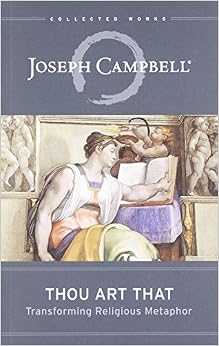
Thou Art That: Transforming Religious Metaphor (The Collected Works of Joseph Campbell), by Joseph Campbell

Download Ebook Thou Art That: Transforming Religious Metaphor (The Collected Works of Joseph Campbell), by Joseph Campbell
Will checking out practice affect your life? Numerous say yes. Checking out is a great habit; you could establish this routine to be such interesting means. Yeah, reviewing practice will certainly not only make you have any kind of preferred activity. It will be among guidance of your life. When reading has come to be a behavior, you will not make it as troubling tasks or as monotonous task. You could acquire lots of benefits and also importances of reading.
Feel difficult to get this best seller book? Why? We presume that best seller book will always go out quickly. So, it's not to weird when you will feel hard to get it in guide shop, or you have to bespeak Thou Art That: Transforming Religious Metaphor (The Collected Works Of Joseph Campbell), By Joseph Campbell when you require it. Have adequate time? Not everyone could wait for log minute to get guide. To conquer this problem, we are here to give you remedy. It is not actually hard for us. We absolutely assist you by offering the checklists of the new best seller publications on the planet.
So, should you read it quickly? Naturally, yes! Ought to you read this Thou Art That: Transforming Religious Metaphor (The Collected Works Of Joseph Campbell), By Joseph Campbell and also finish it fast? Never! You can obtain the pleasurable analysis when you read this publication while delighting in the leisure. Even you do not check out the printed book as right here, you can still hold your tablet and read it throughout. After getting the choice for you to get consisted of in this kind of versions, you can take some ways to review.
When you truly require it as your source, you could locate it now and below, by discovering the web link, you can see it as well as start to get it by saving in your own computer system tool or move it to various other tool. By getting the web link, you will certainly get that the soft documents of Thou Art That: Transforming Religious Metaphor (The Collected Works Of Joseph Campbell), By Joseph Campbell is actually suggested to be one part of your leisure activities. It's clear as well as wonderful adequate to see you really feel so outstanding to get the book to review.
Review
“[A] romp through the Judeo-Christian tradition — a lightning-paced tour with an extremely knowledgeable and provocative guide to illuminate some intriguing, untrammeled paths.”— Publishers Weekly (starred review)“It is Campbell the armchair speaker who shines through, buoyant with life and with comments that are eerily relevant to current times.”— Parabola“The work confirms the commonality of the human experience. A much-needed prescription in today’s world.” — San Francisco Chronicle
Read more
About the Author
Joseph Campbell (1904–1987) is widely credited with bringing mythology to a mass audience. His works, including the four-volume The Masks of God and The Power of Myth (with Bill Moyers), rank among the classics in mythology and literature. Eugene Kennedy, PhD is a psychologist, syndicated columnist, and a professor emeritus of Loyola University Chicago. A laicized Catholic priest, he has written over fifty books on psychology, religion, the Catholic church, and the psychology of religion.
Read more
Product details
Series: The Collected Works of Joseph Campbell
Paperback: 160 pages
Publisher: New World Library (March 5, 2013)
Language: English
ISBN-10: 1608681874
ISBN-13: 978-1608681877
Product Dimensions:
5.5 x 0.2 x 8.5 inches
Shipping Weight: 7.2 ounces (View shipping rates and policies)
Average Customer Review:
4.4 out of 5 stars
56 customer reviews
Amazon Best Sellers Rank:
#324,890 in Books (See Top 100 in Books)
I am an ardent admirer of Campbell, and purchased the Kindle edition of this title eagerly, based on the Amazon reviews. The content, of course, is Campbell at his best and most succinct, but Kindle readers should be aware that this edition suffers from a clunky format, lack of meaningful proofreading, and hideous overuse of badly programmed auto-typing. The letters B.c. show up throughout the text as cryptic auto fill for seemingly random words, making one wish for Robert Langdon's assistance in decoding. This is not a .99¢ edition, this is a full price edition, and it is discourteous to both the author and purchasers to present it in such a fashion. I purchased the hardback edition to give as a gift, and it did not have these issues. Please show your customers the respect of a thoroughly proofread and corrected version to replace this edition in our kindle libraries.
All of the work I have read by Joseph Campbell is amazing, life changing literature and this book was no different.That said, it was tremendously disappointing to see that in this book, when he refers to Christ using a pronoun, such as he him or his, the first letter is capitalized - He, Him, His. However, when referring to other significant historical figures, such as the Buddha, the first letter of the pronouns he him and his are not capitalized.This book was published after Campbell's death and drawn from material in his video recorded lectures and unpublished works. When one looks at the works he published during his life, such as the Hero with a Thousand Faces, one does not encounter this sort of biased capitalization. Christ is referred to as he him or his. The h is not capitalized.This may seem like a minor point of contention, but it is significant to me because Campbell spent his 60+ year career uncovering and illuminating for us the thread of universal truth woven across the tapestry of all religions. So for me at least, this kind of capitalization bias misrepresents his work. It sends an unspoken signal to the reader that he thought one religion was superior to others. He did not. The fact that there is no capitalization bias in the works he published while he was still alive is a testament to that fact. The capitalization bias is, in that regard, a betrayal of his work and his legacy. Joseph Campbell saw and shows us the universal truth of all spiritual paths in his work without bias or preference, that is something that deserves to be honored and preserved.
Read it. Don’t recommend it.He knows a lot about comparative mythology and the language of religious myth as metaphor, some profound connections worth finding.But this book is so short it reads like cliff note summaries of key points. He touches on many common patterns with very little detail. It’s also very loosely organized with random, incomplete insights and connections throughout. I also know enough now about some of these topics to see huge concepts that are entirely missing. He is confusing and does not make his ideas accessible as he should given that his entire career he was a lecturer, writer, and teacher. He is still worth trudging through for the meantime, until I find someone else with his background. I’m just not familiar with this field of study yet.Finally, his bibliography speaks volumes (lol). He only lists his other books as sources. He doesn’t cite or quote other experts in the field or any outside sources. His ideas and his books. Wow dude!Snippets:“The horizontal beam of the specifically Christian Cross is fixed, not as the middle of the vertical beam, but higher, at the level of the Saviors head. At the middle, it would have crossed at the genitals and thereby have represented a phallic centering, like Yahweh’s Old Testament law for those circumcised in the Covenant, where the religion is of the race; whereas the (much later version of) the Christian is of belief, Faith, the mind and heart, to which members of any race whatsoever may be joined.â€
Item timely delivered damage-free as promised. Excellent book! As time passes I am becoming more and more aware that a knowledge of the writings and concepts of both Joseph Campbell and Karl Jung provide an introduction into the mysterious workings of the human unconscious mind, and how these workings affect human mythology and human religion. This is a deep and mysterious subject; and, no matter how much one reads, one never quite reaches the end of it. It is a continuous and life-long study; and for me, the writings of Joseph Campbell and Karl Jung are a excellent place to start. We must continuously remind ourselves many times over that all human knowledge is partial and incomplete; and our study and research never really end. However, what an enjoyable pursuit!
This book is written by The Joseph Campbell foundation based on his works. Here is a pro and con of collected works: The book is written in more modern speech etiquette than Joseph Campbell's original works, making it easier to understand; as the way we speak changed a lot in 50 years. The editors did piece together some information that makes a different meaning out of context with an original work. Example: "Religions protect people from experiencing God." has a different acceptability when read in context within the book, "Inner Reaches of Outer Space".The book brings mysticism into scientific Atheism and helps people accept religion as mythology. Joseph explains how religions share similar archetypes, while being completely different. The source of these religions entered man's imagination from the same infinite mystery; the way the religions where interpreted was based on the persons scientific understanding of that time and place.
Thou Art That: Transforming Religious Metaphor (The Collected Works of Joseph Campbell), by Joseph Campbell PDF
Thou Art That: Transforming Religious Metaphor (The Collected Works of Joseph Campbell), by Joseph Campbell EPub
Thou Art That: Transforming Religious Metaphor (The Collected Works of Joseph Campbell), by Joseph Campbell Doc
Thou Art That: Transforming Religious Metaphor (The Collected Works of Joseph Campbell), by Joseph Campbell iBooks
Thou Art That: Transforming Religious Metaphor (The Collected Works of Joseph Campbell), by Joseph Campbell rtf
Thou Art That: Transforming Religious Metaphor (The Collected Works of Joseph Campbell), by Joseph Campbell Mobipocket
Thou Art That: Transforming Religious Metaphor (The Collected Works of Joseph Campbell), by Joseph Campbell Kindle

0 komentar: